
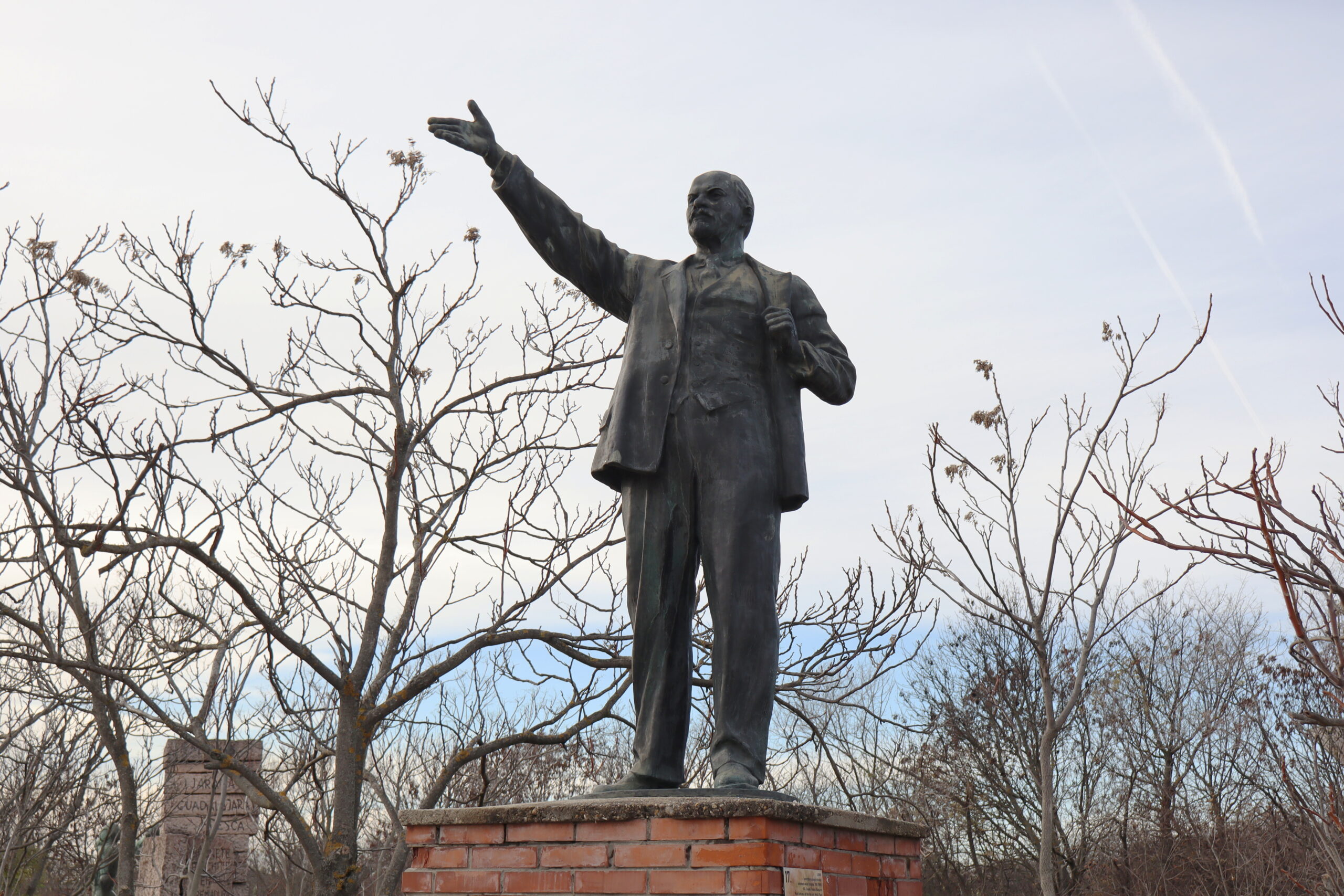
I had the privilege of visiting Memento Park on the outskirts of Budapest recently. Memento Park is a unique museum in that it has actively kept statues from the time of Hungary’s occupation by the Soviet Union (1945-1990).
Following the fall of the Soviet Union across 1989/90 most of the statues with a communist agenda were either melted down or vandalised. However, in 1993 Memento park was established, the city council determining in conjunction with a cultural committee which statues were worth keeping for historical documentary reasons. The result is a collection of 41 statues of communisms finest art displayed across the outdoor museum.
Almost immediately you are greeted with separate statues of Lenin, as well as Karl Marx and Friedrich Engels – Marx and Lenin being perhaps the most bronze and granite immortalised figures of communism. Lenin’s statue decorated with flowers as the anniversary of the 7th of November 1917 communist uprising in Russia had recently passed. My guide Zoltan explaining how the Hungarian Communist Party providing had generously provided the décor for Lenin.
I opted for the guided tour (which with entry was 7500huf or around $35aud) and the guidebook (2000huf or $10aud). Zoltan was very knowledgeable about the history of the statues such as where they were originally placed, what they signified from an official Soviet Union perspective and what the more subtle propaganda message was hidden within the statues. Previously I had never been aware of the difference between Stalin-ist and post Stali-ist era statues however now I won’t miss an opportunity to point out the difference.
Having lived in Budapest for the last 6 months I have become interested in Hungarian history and have taken the opportunity to absorb some of that history just existing in and around the city – taking in names of Metro Stations, reading books etc. However seeing these statues in real life in the museum makes me imagine them atop sites I have visited many times over. I imagine how walking past Jaszai Mai ter and seeing Marx and Engels staring back at you would prompt some uneasy feelings these days. Whereas the communist leaders of the satellite state of Hungary would have seen these busts as a nod of respect to those who had pioneered their societal system, the inhabitants of Budapest who had lived through a previous period of democracy would have viewed the towering figures of those intellects who conceived their current oppression.
Removing communism statues was one way to eradicate any memories of communism following the fall of the soviet union, however present day Budapest is one step further removed in that streets and squares formally named after communist counterparts have been renamed to reflect the cities Hungarian history, rather than honour its oppressor. For instance, Szell Kalman Ter, a lively outdoor square and adjoining transport hub was formally Moszkva (Moscow) Ter.
Back at Memento Park the architect of the complex has incorporated clever symbolism within the design of the park. The statues are shaped around three figure of eight symbols with a central straight path in the middle– symbolising that the different paths ultimately lead back unto the central path that is the only true and right road. And a seemingly unnecessary narrow alley at the start of the park signifies how the Hungarian citizens must have felt trapped in by the walls of this new system as the reality of their occupation by the Soviet Union set in.
Memento park makes for a great place to spend a few hours observing the sombre monuments of an era of oppression that otherwise would have been destroyed. If you are particularly interested in communism or looking to gain a more complete understanding of Hungarian history I would highly recommend it. My advice would be to take the excellent guided tour which can be booked in advance or at the ticket counter on the day of your visit, or purchase the guidebook as the statues really benefit from having a detailed explanation of what they represent and how they fit in with Hungary’s and communism’s history.